T H E L I V I N G C E N T E R O F T H E F A I T H
Do You Know What
Stands Before You?
Not a symbol. Not a memory. Not a metaphor.
The Creator of the universe, waiting in the silence.
Four Worlds, One Altar
Whoever you are, whatever your history with the Church, the reality on the altar remains unchanged. It waits for you.
The Lapsed
You walked away years ago. The rules felt hollow, the homilies disconnected, the culture foreign. You remember the motions, but the fire never caught. We do not judge your leaving. But we ask you to look at what was left behind.
The Devout
Every Sunday, without fail. You volunteer, you tithe, you pray. You are the backbone of the parish. Yet familiarity can breed blindness. Have the profound mysteries of the altar become just another part of the weekend routine?
The CEO
Christmas and Easter Only. You respect the tradition, you bring the family, you find peace in the carols and the lilies. It's a nice anchor in a chaotic year. But what if the anchor was meant to be a daily lifeline?
The Latin Masser
You found refuge in the ancient rite. The silence, the chant, the ad orientem posture—it speaks to your soul's desire for reverence. But reverence must translate into charity, or the incense is just smoke.
Body, Blood, Soul, and Divinity.
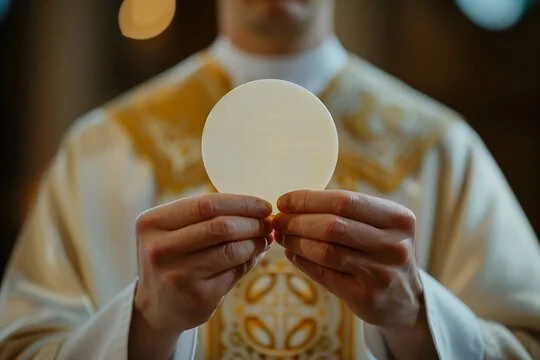
It is the scandalous, breathtaking claim at the dead center of the Catholic faith: the Eucharist is not a symbol. It is not a reminder. It is not a piece of bread that represents Jesus.
At the moment of consecration, when the priest speaks the words of Christ—"This is my body, given for you"—the substance of the bread and wine completely ceases to be. It is transformed, in its very essence, into the living, breathing reality of Jesus Christ.
This is the dogma of the Real Presence. It is heavy. It defies human logic. It demands a response. If it is false, Catholics are committing idolatry by worshiping bread. But if it is true... it changes everything about how we must live.
"If it's just a symbol, to hell with it."
— FLANNERY O'CONNOR
30% Believe
The Stunning Collapse
Recent polling reveals a devastating truth: barely 30% of self-identified Catholics believe in the Real Presence.
Seven in ten Catholics sitting in the pews believe the Eucharist is merely a symbol. They approach the altar to receive what they believe is a wafer of bread. The theological core of the faith has been quietly hollowed out.
How did we get here? A failure of catechesis. A drift into cultural assimilation. Liturgies that stripped away reverence and replaced it with banality. When we stopped acting like the Creator of the Universe was on the altar, people stopped believing He was.
What the Eucharist Can Do For You
Not self-help. Not a psychological coping mechanism. Ontological transformation.
Healing of the Soul
It operates on the wounds you cannot reach. The Eucharist is medicine for the sick, dissolving venial sins and fortifying the soul against spiritual decay.
Union with Christ
You become what you consume. It is the most intimate physical and spiritual union possible on earth, grafting your humanity onto His divinity.
Grace for the Fight
The world will break you down. The Eucharist provides the supernatural stamina required to endure suffering, love your enemies, and pursue sanctity.
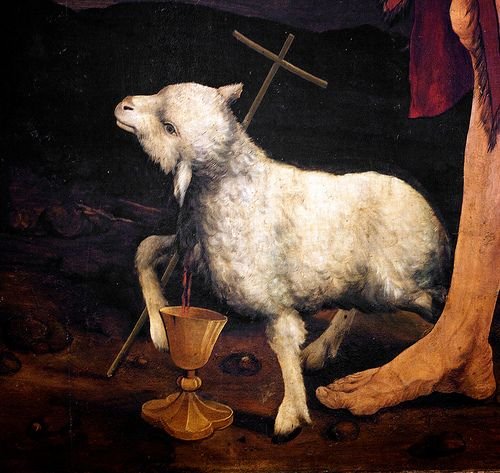
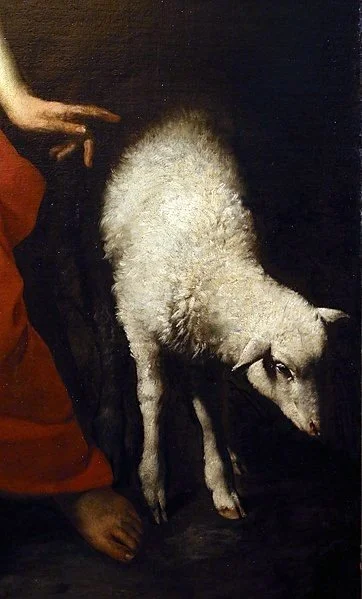
"Behold, the Lamb of God, who takes away the sin of the world."
— JOHN 1:29
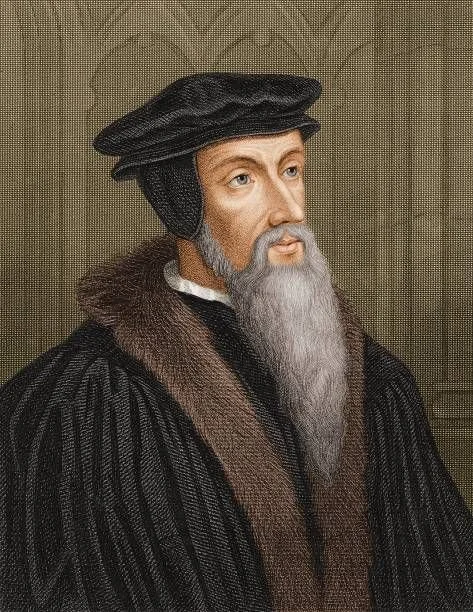
During the Reformation, John Calvin flatly rejected the Real Presence. For him, the bread and wine remained bread and wine—merely symbolic memorials, spiritual reminders of Christ's distant sacrifice.
Why does a 16th-century Protestant theologian matter to a Catholic today? Because without realizing it, Calvin's theology has quietly conquered the Catholic pews.
When modern Catholics say the Eucharist is a "symbol of unity" or a "community meal," they are speaking pure Calvinism. The tragedy is not just that they are wrong; it is that they have traded a supernatural earthquake for a nice sentiment.
The Shadow of Geneva
THE CONTRAST
The Protestant View
"It makes us think of Jesus." (Memorial)
The Catholic Reality
"It is Jesus." (Substantial Presence)
The Source and Summit
"The Church draws her life from the Eucharist. This truth does not simply express a daily experience of faith, but recapitulates the heart of the mystery of the Church."
— POPE ST. JOHN PAUL II, ECCLESIA DE EUCHARISTIA
For John Paul II, the Eucharist was not one sacrament among many; it was the gravitational center of the cosmos. His personal devotion—spending hours prostrate on marble floors before the tabernacle—was the fuel for a papacy that changed world history.
A STORY OF THE SAINTS
The Mule Who Knew His Maker
In 13th-century Rimini, a Cathar heretic named Bononillo challenged Saint Anthony of Padua. Bononillo mocked the doctrine of the Real Presence, demanding proof that the Host was anything more than baker's bread.
Anthony proposed a wager. Bononillo would starve his mule for three days. On the third day, Anthony would bring the consecrated Host, and Bononillo would bring a pile of fresh oats. They would see which the starving beast preferred.
On the appointed day, a crowd gathered in the piazza. Bononillo laid out the fragrant oats. Anthony stepped forward holding the monstrance containing the Blessed Sacrament.
"In the name of your Creator, whom I hold in my hands," Anthony commanded, "I tell you to come and show reverence."
Ignoring the food, the starving beast walked to the saint, bowed its front legs, and knelt before the Host.
WATCH · 21 MINUTES
"The Mass"
Fr. Mark Beard — Saint Helena Catholic Church. Preached on the Solemnity of the Body and Blood of Christ, 2023. Over half a million views.
No Altar, No Eucharist
Fr. Beard walks through the logical chain: without an altar there is no sacrifice; without a sacrifice there is no Eucharist. And without a priest in the line of Melchizedek back to Peter, there is no altar. Every element is load-bearing.
Everything Is Scriptural
"Everything in the Mass is scriptural — nobody is making anything up." From Moses standing before the glory cloud to the bells at consecration, every gesture and word traces back to the Old and New Testaments.
The Church Is a Crucifix
"His feet are at the door, his head is at the tabernacle, his wound is at the altar." Fr. Beard explains why he kisses the altar — and why the shape of the building itself is a proclamation of the Passion.
"If you are God — will you tell me how you wish to be worshiped, or will you leave it up to me?"
— FR. MARK BEARD
"We come to worship Him and adore Him — not to be entertained by Him."
— FR. MARK BEARD
Two Forms, One Sacrifice
The way we pray shapes what we believe. Lex orandi, lex credendi. A fair look at how the two forms of the Roman Rite frame the mystery of the Eucharist.
The Novus Ordo
THE ORDINARY FORM
Versus Populum (Facing the People). The priest generally faces the congregation across a free-standing altar. It emphasizes the communal meal and the gathered assembly.
The Vernacular: Prayed in the local language, ensuring immediate comprehension of the prayers and readings by the faithful.
Active Participation: Emphasizes vocal responses, lay lectors, and extraordinary ministers. The congregation's role is outward and audible.
Communion in the Hand: The faithful typically receive standing and in the hand, a practice reintroduced in the 20th century.
The Traditional Latin Mass
THE EXTRAORDINARY FORM
Ad Orientem (Facing God): The priest and the people face the same direction—liturgical East, toward the tabernacle and the cross. He acts as the leader of a procession toward God.
Sacred Language (Latin)Prayed in an ancient, unchanging tongue reserved solely for divine worship, creating a veil of sacred mystery.
Profound Silence: The Roman Canon is prayed by the priest in a whisper. The silence demands an interior, contemplative participation from the faithful.
Kneeling and on the Tongue: Communion is received exclusively kneeling at the altar rail, directly on the tongue, reinforcing the absolute fragility and sanctity of the Host.
99%
ATTEND MASS EVERY SUNDAY
4.5×
MORE LIKELY TO FULFILL THE SUNDAY OBLIGATION VS. NON-CATHOLICS
5×
MORE DONATED TO THE CHURCH PER HOUSEHOLD
2%
APPROVE OF ABORTION (VS. 51% NATIONALLY)
60%
LARGER AVERAGE FAMILY SIZE
7–8×
MORE PRIESTLY & RELIGIOUS VOCATIONS (PRELIMINARY)
Source: Fr. Donald Kloster, Traditional Latin Mass National Survey, 2018–19. n = 1,322 in-pew respondents across 11 states.
The Fruit of Reverence
In 2018–19, Fr. Donald Kloster conducted the first national survey of Traditional Latin Mass attendees, gathering 1,322 in-pew responses across five states and 451 online responses from six more. The data was analyzed by a Ph.D. statistician and directly compared against CARA and Pew Research benchmarks for ordinary-form Catholics.
The differences were not marginal. They were staggering. TLM Catholics attend Mass at 4.5 times the rate of NOM Catholics, donate five times more per household, and have families nearly 60% larger. Preliminary data suggested 7–8 times more priestly and religious vocations.
Why? It is not because they are inherently better people. It is because the liturgy teaches them.
When you enter a dark church, smell incense, hear ancient chant, and watch a priest handle the Host as if a single falling crumb would be a cosmic tragedy — you do not need a theology degree to know that something profoundly holy is happening. Reverence breeds belief. Casualness breeds apathy.
Data: Kloster, Fr. D. "Traditional Latin Mass National Survey." Published in LiturgyGuy.com, Feb. 24, 2019. Statistics consultant: Sha Balizet Fisher, Ph.D.
A GENERATIONAL TURNING POINT
The Youth Are Demanding the Sacred
For fifty years, the strategy to keep young people in the Church was to make the Church look like the world. Guitars, informal language, felt banners, and a relentless focus on community. The result was a catastrophic exodus.
But something strange is happening with Gen Z. The young adults who are converting, returning, or staying are completely uninterested in a Church that mimics the secular world. They have enough entertainment on their phones. They have enough community in their secular lives.
What they want is the transcendent. They want the ancient. They want the difficult.
21%
of Gen Z identifies as Catholic — up from 15% just two years prior, surpassing Millennials
Harvard CCES Election Study, 2023
#1
Gen Z leads all generations in church attendance, averaging 23 services per year
Barna Group, 2025
Most
Young Catholics (18–29) are "by far the most engaged" — highest rates of Mass, Confession, and Eucharistic Adoration
Leadership Roundtable, Nov. 2025
"Gen Z is the least religious generation in U.S. history. And Gen Z is going to church more than any other generation. Both of these statements appear to be true."
— THE EDITORS, AMERICA MAGAZINE, DECEMBER 11, 2025[AM]
"The devout Christian of the future will either be a 'mystic' — someone who has 'experienced something' — or will cease to be anything at all."
— KARL RAHNER, S.J. — CITED IN AMERICA MAGAZINE, DECEMBER 11, 2025
According to a November 2025 report from the Leadership Roundtable, young Catholics aged 18–29 are not just attending Mass — they are the most likely of any age group to engage in parish activities, go to Confession, and attend Eucharistic Adoration. The rise of the "nones" has plateaued. The committed remnant is growing younger, not older.
Look at the pews of any Traditional Latin Mass, or any reverent Novus Ordo parish that offers Eucharistic adoration and orthodox preaching. You will not find mostly gray hair. You will find twenty-somethings, young families, veils, and a fierce, unapologetic devotion to the Real Presence. The future of the Church belongs to those who kneel.
What Must Be Done
Belief in the Real Presence will not be restored by committee documents or diocesan programs. It will be restored by a radical, visible change in how we treat the Eucharist.
For the Clergy
Preach the Hard Truth: Stop speaking of the Eucharist in vague terms of "unity" and "meal." Preach the doctrine of Transubstantiation clearly, repeatedly, and without apology.
Restore Liturgical Reverence. Eliminate profane music. Observe strict silence before and after Mass. Reintroduce Latin chant. Let the Ars Celebrandi (art of celebrating) scream to the congregation that God is present.
Bring Back the Altar Rail. If the Host is truly God, receiving Him standing and in the hand while shuffling in a crowded line is psychologically discordant. Encourage kneeling and receiving on the tongue.
Expand Adoration. Leave the church doors open. Expose the Blessed Sacrament. A parish without regular Adoration is a parish fighting a war without weapons.
For the Laity
Show Up Early, Stay Late. Arrive 15 minutes early to pray in silence. Stay 10 minutes after Mass to offer a thanksgiving. Break the habit of treating Mass like a consumer transaction.
Fast Properly: The one-hour fast is a bare minimum. Try fasting from midnight, or for three hours before Communion. Let physical hunger prepare the way for spiritual hunger.
Genuflect Like You Mean It: When you cross the tabernacle, drop your knee to the floor. Teach your children to do the same. Bodily posture dictates mental assent.
Bring the Fallen Away: Do not nag them. Invite them to a reverent Mass or a period of silent Adoration. The argument is rarely won with words; it is won by exposure to the Sacred.